

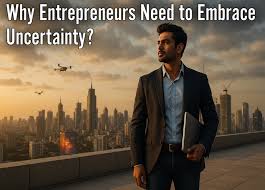
Entrepreneurship has always been a dance with uncertainty. Yet, among the thousands who step into the arena, only a select few consistently turn volatility into opportunity. What sets these elite entrepreneurs apart isn’t just capital or connections—it’s their psychological approach to risk. Understanding how they strategically embrace and control uncertainty is one of the most underexplored yet powerful aspects of entrepreneurial mastery.
The Shift from Risk Avoidance to Risk Engineering
Most people are conditioned to avoid risk. But top-performing entrepreneurs don’t merely tolerate risk—they engineer it. They deliberately create asymmetric situations where the downside is limited, but the upside is exponential.
Take for instance, how seasoned entrepreneurs design experiments instead of commitments. They launch micro-tests before investing heavily, transforming large, uncontrollable risks into smaller, testable assumptions.
This shift in mindset—from fear-based avoidance to calculated experimentation—is the foundation of sustainable entrepreneurial success. It’s not about recklessness; it’s about structure and control within uncertainty.
The Cognitive Advantage: Thinking in Probabilities, Not Certainties
Elite entrepreneurs operate from a probabilistic mindset. Instead of asking, “Will this idea work?” they ask, “What’s the likelihood this will work, and what are the variables that affect that probability?”
This subtle mental model separates visionaries from impulsive dreamers. They know that success in business is rarely black or white—it’s a weighted balance of multiple uncertain outcomes.
By developing what psychologists call Bayesian thinking, these entrepreneurs constantly update their beliefs as new information emerges. This dynamic thinking style helps them avoid cognitive rigidity—the trap where founders stick to a failing plan simply because it was their idea.
Strategic Emotional Intelligence: Managing Fear and Overconfidence
Risk doesn’t just test logic—it tests emotions. Even the most rational strategies collapse under the weight of fear, ego, or overconfidence. Elite entrepreneurs have mastered emotional calibration, an ability to manage both the highs and lows of uncertainty.
They practice emotional objectivity, detaching their identity from their ideas. This allows them to pivot without ego or hesitation when evidence points elsewhere.
Equally, they cultivate measured confidence—not the loud bravado of the reckless, but the calm assurance that comes from preparation and clarity. This balance between fear management and confidence control forms the psychological bedrock of sound risk-taking.
Building “Anti-Fragile” Systems: Thriving in Chaos
Inspired by Nassim Nicholas Taleb’s concept of antifragility, high-level entrepreneurs design businesses that benefit from volatility rather than break under it.
They build modular business systems—structures that can evolve quickly when external shocks occur. This might involve:
-
Diversifying revenue streams to prevent dependency on a single market.
-
Creating flexible partnerships that can adapt to new opportunities.
-
Using technology and automation to scale up or down efficiently.
When crises hit, these systems don’t just survive—they improve. Each disruption becomes a data-rich stress test, revealing weak links and new opportunities simultaneously.
Decision Velocity: The Invisible Advantage
In the high-speed world of entrepreneurship, decision velocity—how quickly and effectively you make decisions—often determines long-term success.
Elite entrepreneurs understand that speed compounds. Making a good decision quickly can be more valuable than making a perfect one too late. They rely on frameworks like the OODA Loop (Observe, Orient, Decide, Act), originally developed for fighter pilots, to outpace competitors.
Here’s how they apply it in business:
-
Observe: Constantly gather real-time feedback from customers, markets, and teams.
-
Orient: Reinterpret the data through multiple perspectives, questioning assumptions.
-
Decide: Make the most informed decision possible in the moment.
-
Act: Execute fast—and adjust immediately when new information emerges.
This iterative decision-making model allows entrepreneurs to stay agile, learn faster than the competition, and maintain strategic momentum even in uncertainty.
The Power of Contrarian Insight
Every significant entrepreneurial leap begins with a contrarian observation—seeing what others overlook or reject. The world’s most successful founders often identify truths that are non-obvious, counterintuitive, or even unpopular.
But contrarian thinking isn’t about being different for the sake of it. It’s about deep pattern recognition—seeing emerging shifts in technology, behavior, or markets that signal untapped opportunity.
Elite entrepreneurs develop contrarian discipline, which includes:
-
Independent validation: They test assumptions against data, not opinion.
-
Long-term patience: They wait for the market to catch up to their vision.
-
Resilience against doubt: They’re mentally equipped to endure skepticism and rejection.
This mindset allows them to innovate at the edges of convention, where the highest rewards—and highest risks—reside.
Creating Psychological Leverage Through Focus
While most entrepreneurs juggle endless priorities, the elite understand that focus itself is leverage. They obsess over clarity of intent—knowing precisely what drives disproportionate results.
They practice what’s known as “selective intensity”—concentrating massive effort on a few high-impact goals while ruthlessly eliminating distractions.
This focus multiplies productivity because:
-
It channels cognitive energy into fewer, higher-value decisions.
-
It simplifies operations and amplifies execution power.
-
It strengthens resilience by reducing mental overload.
By mastering focus, entrepreneurs gain psychological leverage—the ability to move mountains with minimal wasted effort.
Transforming Uncertainty into Identity
At the highest levels, entrepreneurship becomes less about building companies and more about building an identity that thrives on ambiguity.
Elite entrepreneurs see uncertainty not as an external enemy but as an internal challenge—a signal to grow their adaptability, awareness, and creative intelligence.
They integrate uncertainty into their identity through three transformative beliefs:
-
Ambiguity is information. Every unclear situation holds data waiting to be decoded.
-
Failure is refinement. Every misstep filters out what doesn’t work.
-
Chaos is potential. Every unstable moment carries the seed of innovation.
This identity-level transformation turns uncertainty from a source of stress into a strategic advantage.
The Entrepreneur’s Inner Architecture
Ultimately, the difference between ordinary entrepreneurs and elite ones lies in their inner architecture—the way they think, feel, and respond under pressure.
Their psychology is not static; it’s intentionally designed. Through continuous self-reflection, strategic mindfulness, and structured learning, they shape their mental landscape to withstand volatility.
They are architects of both businesses and minds, building internal systems of resilience that mirror their external ventures.
FAQs
1. How can experienced entrepreneurs strengthen their tolerance for uncertainty?
By engaging in controlled risk-taking—testing ideas in small, reversible ways—and by tracking emotional responses during uncertainty to identify cognitive biases.
2. What role does emotional intelligence play in strategic risk management?
Emotional intelligence helps entrepreneurs recognize and regulate fear, ego, and overconfidence, enabling objective decision-making under pressure.
3. How do elite entrepreneurs recover from major failures?
They treat failure as a diagnostic tool. Instead of emotional collapse, they analyze patterns, refine assumptions, and iterate forward with renewed precision.
4. Can the principles of antifragility be applied to startups?
Yes. Startups can adopt modular systems, diversified revenue models, and adaptable processes that allow them to grow stronger from stress and volatility.
5. How does decision velocity influence a company’s growth?
High decision velocity enables faster learning cycles, quicker pivots, and sustained momentum—creating a compound advantage over slower-moving competitors.
6. What differentiates contrarian insight from risky intuition?
Contrarian insight is data-driven and pattern-based, while risky intuition relies on emotion or guesswork. The best entrepreneurs balance instinct with validation.
7. How can entrepreneurs cultivate focus in a distraction-heavy environment?
By setting a single high-impact goal per quarter, delegating low-value tasks, and maintaining a deliberate “no list” to protect cognitive bandwidth.
