

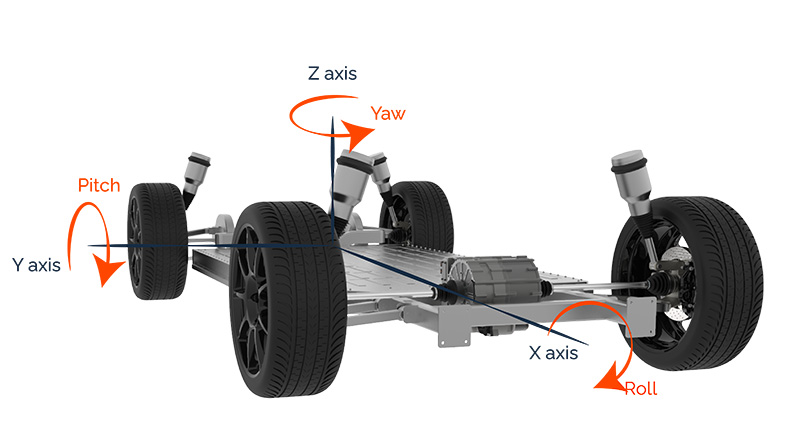
Electric vehicles (EVs) have revolutionized propulsion, but the real renaissance in driving dynamics is happening under the skin — in adaptive torque vectoring systems. Far from a buzzword, adaptive torque vectoring is a sophisticated control strategy that uses high-bandwidth sensors, electric motor actuation, and predictive algorithms to redistribute torque between wheels in real time. This article examines how adaptive torque vectoring works, why it matters for modern EV platforms, its measurable benefits, implementation challenges, and practical implications for OEMs, tuners, and experience-driven drivers.
Why torque vectoring matters now (and why EVs accelerate its importance)
Traditional mechanical differentials and stability control systems have long tried to balance traction and yaw control. EVs change the game because they:
-
Offer independent, instantaneous motor control at each axle or wheel.
-
Provide high torque availability from zero rpm, increasing the need for precise distribution.
-
Allow software-defined dynamic behavior, enabling frequent and OTA updates.
These factors make EVs uniquely suited for adaptive torque vectoring — systems that continuously change their strategy based on driving context instead of applying fixed rules. The result is better cornering precision, improved energy efficiency, and a safer, more confidence-inspiring driving experience.
How adaptive torque vectoring works: sensors, models, and actuators
Adaptive torque vectoring is a closed-loop control system. Its core components:
1. Sensing layer
The system ingests a rich set of signals:
-
Wheel speeds (individual)
-
Yaw rate and lateral/longitudinal acceleration (IMU)
-
Steering angle and torque
-
Motor torque and inverter state
-
Wheel slip estimates and, where available, surface condition sensors
These inputs feed into predictive models that estimate vehicle state with very low latency.
2. Control and prediction layer
This is the system’s brain:
-
Model Predictive Control (MPC) or advanced state-space controllers forecast vehicle trajectory several hundred milliseconds ahead and solve an optimization to allocate torque.
-
Driver intent estimation (e.g., aggressive steering inputs vs. cruising) tunes control aggressiveness.
-
Energy-aware objectives balance handling improvement with efficiency loss — essential for range-sensitive EVs.
3. Actuation layer
-
Direct-drive wheel motors or in-wheel / dual-motor axle setups provide the physical means to apply differential torque.
-
High-speed communication (CAN-FD/Ethernet) and fast inverters ensure commands become torque changes almost instantaneously.
Tactical benefits: what adaptive torque vectoring delivers on the road
When implemented well, adaptive torque vectoring delivers measurable, perceptible gains:
1. Enhanced cornering speed and stability
-
By applying additional torque to the outer wheel and reducing inner-wheel torque, the system creates a yaw moment that helps rotate the vehicle into the corner with less steering input.
-
The result: higher safe cornering speeds, reduced understeer, and more neutral handling balance.
2. Improved traction and recovery
-
On slippery surfaces, the controller can quickly transfer torque to wheels with traction, enabling faster recovery from slip and reducing the need for intrusive braking-based stability interventions.
3. Reduced energy losses
-
Unlike brake-based stability control, torque vectoring uses propulsive forces to influence yaw — which can be more energy-efficient when orchestrated intelligently.
-
Adaptive systems that factor in energy cost can choose torque splits that minimize battery drain while maintaining a target handling profile.
4. Personalized driving dynamics
-
Software tuning allows OEMs or drivers to select modes (Comfort, Sport, Track) that change torque vectoring aggressiveness and intervention thresholds, enabling both safety-focused and performance-focused behaviors.
Implementation challenges and trade-offs
Adaptive torque vectoring is powerful — but not trivial to deploy:
Hardware dependencies
-
Requires independent motor control at the axle/wheel level for full benefit. Single-motor, single-axle EVs have limited scope.
-
High-fidelity IMUs and fast sensing networks are necessary to avoid latency-induced instabilities.
Control complexity
-
Designing robust MPC that handles sensor noise, actuator saturation, and nonlinear tire behavior across temperatures and surfaces is difficult.
-
Controllers must gracefully revert to safe fallbacks in the event of sensor faults.
Thermal and mechanical limits
-
Aggressive torque transfers can overload motor/inverter thermal budgets and stress driveline components. Adaptive strategies must include thermal-aware constraints.
Regulatory and warranty considerations
-
Aggressive software behaviors risk customer dissatisfaction if they feel inconsistent or unpredictable. OEMs must balance excitement with predictability and durability to avoid warranty claims.
Best practices for OEMs and tier-1 suppliers
To extract maximum value without compromising reliability, manufacturers should follow these guidelines:
1. Co-design across domains
-
Integrate drivetrain, vehicle dynamics, and thermal teams early. Torque vectoring touches power electronics, suspension tuning, and control software simultaneously.
2. Energy- and thermal-aware optimization
-
Include battery SOC, inverter/motor temps, and vehicle range targets within the objective function so torque vectoring scales back under constrained conditions.
3. Layered safety architecture
-
Implement monitoring, graceful degradation, and deterministic fallbacks (e.g., revert to open-loop torque maps or stability control) to maintain predictable behavior on faults.
4. Extensive real-world validation
-
Simulations and track tests are necessary but insufficient. Validate across wet, snow, gravel, and hot/cold climates, and with diverse driver profiles to tune adaptivity parameters.
5. OTA update strategy
-
Use telemetry and fleet learning to refine models post-launch, but gate updates behind rigorous A/B testing and user experience evaluation to avoid surprises.
Real-world applications beyond handling: towing, efficiency, and ADAS synergy
Adaptive torque vectoring’s value extends past cornering:
-
Towing and load management: On tow-heavy EV pickups, vectoring can offset destabilizing moments caused by trailer sway and uneven loads.
-
Range optimization: Smart vectoring that slightly alters yaw behavior to reduce slip can reclaim energy lost to tire scrubbing during aggressive maneuvers.
-
ADAS integration: Coupling torque vectoring with autonomous steering and path-following allows smoother lane-keeping and evasive maneuvers that use traction instead of heavy braking.
What tuners and aftermarket innovators should know
For performance tuners and aftermarket developers, adaptive torque vectoring opens new doors — but proceed carefully:
-
Hardware-first: Without multi-motor control, retrofitting vectoring is limited. Consider motor/inverter upgrades when viable.
-
Software safety: Tuning must respect OEM limits; bypassing thermal protections or torque caps endangers equipment and safety.
-
User experience: Make mode changes intuitive and transparent — unexpected torque nudges will feel like instability without clear user intent mapping.
Hurdles for consumer acceptance
Beyond the engineering, manufacturers must address user perceptions:
-
Predictability vs. performance: Consumers prefer predictable handling. Too-aggressive adaptivity can feel twitchy.
-
Transparency: Educating buyers about benefits (range, safety, performance) without overwhelming them helps adoption.
-
Maintenance and diagnostics: Clear diagnostics and customer-friendly maintenance paths reduce worry about complexity.
Future directions: learning systems and wheel-level intelligence
The next wave of advances will blend machine learning, wheel-level sensing, and vehicle-to-infrastructure inputs:
-
Self-tuning controllers that adapt parameters to individual drivers over time using reinforcement learning techniques.
-
Tire condition monitoring feeding into vectoring logic to adapt to tread wear or punctures in real time.
-
Cooperative vectoring where fleets or infrastructure sensors inform optimal control strategies during dynamic events (e.g., coordinated evasive maneuvers).
These developments will push torque vectoring from a feature into a continuous improvement platform that evolves with the vehicle.
FAQ:
Q1: Can adaptive torque vectoring improve EV range in city driving?
Short answer: Yes — when configured to minimize wheel slip and unnecessary braking, adaptive torque vectoring can recover small but measurable amounts of energy, especially in stop-start city conditions with tight maneuvers.
Q2: Is torque vectoring effective on single-motor EVs?
Short answer: Limited. Single-motor, rear- or front-drive vehicles can use brake-based yaw control, but this is less efficient and responsive than motor-based vectoring available in multi-motor architectures.
Q3: How does torque vectoring affect tire wear?
Short answer: If not tuned properly, aggressive vectoring can increase localized tire scrubbing and accelerate wear. Energy- and wear-aware control strategies mitigate this by including tire wear models in the optimization cost.
Q4: Can aftermarket systems safely add torque vectoring to existing EVs?
Short answer: Only with caution. Without proper access to motor controllers and adherence to thermal/torque limits, aftermarket retrofits risk equipment damage and safety issues. Collaborations with OEMs or certified tier-1 suppliers are recommended.
Q5: Does adaptive torque vectoring replace electronic stability control (ESC)?
Short answer: No. Torque vectoring complements ESC; ESC remains the safety backbone. Vectoring reduces reliance on brake-based interventions but should be integrated with ESC for fail-safe behavior.
Q6: What sensors are most critical for robust vectoring on low-friction surfaces?
Short answer: High-quality wheel speed sensors, a precise IMU (yaw/lateral acceleration), and steering angle sensors are essential. Additional surface-detection sensors or camera-based friction estimation improves adaptivity but adds complexity.
Q7: How will autonomous driving change the role of torque vectoring?
Short answer: As autonomy demands precise and repeatable vehicle responses, torque vectoring becomes a core actuator to execute smooth, energy-efficient maneuvers — particularly for emergency path planning where braking alone is insufficient.
